Summary
The Toyota RAV4 is one of the most reliable midsize SUVs on the road, but not all model years age equally. Certain engines, transmissions, and hybrid systems show repeatable failure patterns when early warning signs are ignored. This guide breaks down what actually fails, why it fails, and how informed owners avoid expensive mistakes.
Is the Toyota RAV4 actually reliable?
Short answer: yes, but reliability depends heavily on engine choice, generation, and service discipline.
The RAV4 consistently ranks above average in long-term reliability surveys, including What Car? and Auto Express. However, high reliability scores hide year-specific mechanical weaknesses. Owners who understand known engine, transmission, and electrical risks experience far fewer failures over 200,000 km.
Why do some RAV4 years perform better than others?
Short answer: later revisions correct early design flaws and software weaknesses. Toyota tends to refine engines and control software mid-cycle. Early production years often reveal piston ring, ECM, or transmission calibration issues that are corrected in later updates. Facelift and late-cycle RAV4s benefit from improved engine internals, revised electronics, and more stable drivetrain tuning.
Excessive oil consumption in petrol RAV4s (2006–2012, 2AZ-FE)
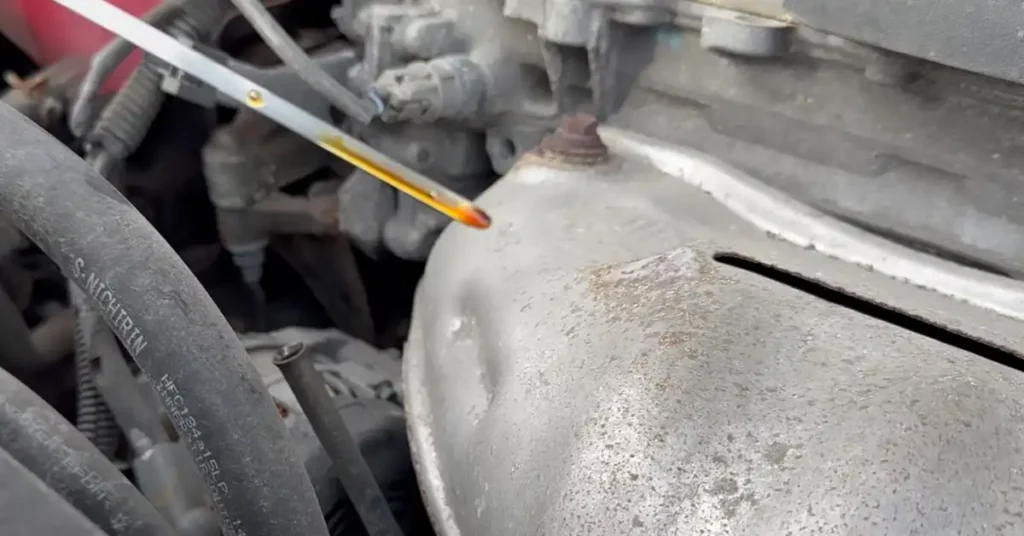
Short answer: piston ring design allows oil to pass into the combustion chamber.
Third-generation RAV4 models using the 2.0- and 2.4-litre 2AZ-FE petrol engine are known for progressive oil consumption. The oil control rings fail to scrape excess oil from the cylinder walls, leading to gradual but significant oil loss.
Technical problem statement
Oil burns internally due to insufficient ring tension and carbon buildup. The engine often runs smoothly, masking the issue until oil drops dangerously low.
Diagnostic verification
- Measure oil consumption over 1,600–2,000 km
- Inspect spark plugs for oil fouling
- Perform compression and leak-down testing
- Inspect PCV valve and crankcase ventilation
- Check for sludge restricting oil return passages
Correct repair strategy
- Short intervals oil changes using correct viscosity
- PCV replacement and ventilation cleaning
- Piston ring replacement or short-block rebuild when compression loss is confirmed
Technician insight: Many engines fail due to neglect, not sudden damage. Owners topping up oil without diagnosis often delay irreversible wear.
Hybrid system faults (2016–present RAV4 Hybrid)
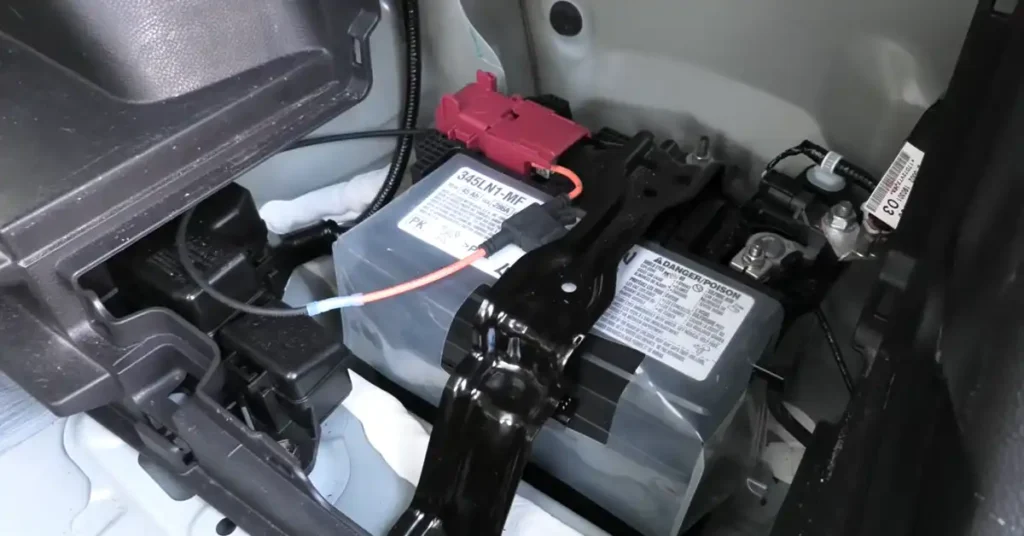
Toyota RAV4 12-volt auxiliary battery
Short answer: most hybrid shutdowns originate from the 12-volt auxiliary battery, not the high-voltage pack.
Hybrid RAV4s rely on a conventional 12-volt battery to boot control modules. Weak batteries cause hybrid warnings, inverter faults, or complete system shutdown.
Common root causes
- Weak or incorrectly sized 12-volt battery
- Inverter cooling issues
- Software calibration errors
- Rare inverter internal failure
Diagnostic process
- Load-test 12-volt battery under electrical load
- Scan hybrid ECU for inverter and isolation faults
- Verify inverter coolant pump operation
- Inspect ground points and battery terminals
Forum pattern: Toyota forums and Reddit consistently show hybrid warnings resolved after proper battery replacement and ECU reset.
Transmission hesitation and ECM-related shifting issues
Short answer: hesitation is usually calibration-related, not mechanical failure.
Early models (2001–2003)
Second-generation RAV4s suffered ECM faults that caused harsh or missed shifts. Toyota extended warranty coverage for affected vehicles.
Newer models (2019–2021)
Owners report hesitation from a rolling start or light throttle. This is linked to transmission logic and ECM torque management.
Correct fix path
- Scan ECM and TCM for adaptive data
- Update software where applicable
- Verify transmission fluid condition
- Road-test with live RPM and torque data
Replacing gearboxes without confirming software faults leads to repeat complaints.
CVT and hybrid transmission behaviour (2019–2021)
Short answer: perceived “slip” is often torque smoothing behaviour.
Hybrid e-CVT systems operate differently from traditional automatics. Hesitation complaints usually relate to throttle mapping or outdated hybrid software.
Maintenance best practice
- Annual hybrid system calibration check
- Strict adherence to fluid service intervals
- Avoid aggressive throttle at low speeds
Electrical system problems and fire-risk recalls
Short answer: battery mounting faults cause most serious electrical risks.
Toyota issued recalls for battery tray and hold-down hardware on several RAV4 years after reports of battery movement causing terminal shorting.
Inspection checklist
- Confirm correct battery size
- Inspect hold-down clamp and tray
- Check terminal insulation covers
- Verify recall completion via VIN
Minor electrical complaints such as infotainment resets or EPS warnings often trace back to voltage instability.
Steering system problems (EPS and steering shaft)
Short answer: electric power steering faults are usually electrical, not mechanical.
Common symptoms
- Clunking or clicking when turning
- Heavy steering at low speeds
- Intermittent EPS warning lights
Causes
- Steering shaft wear on older models
- Water ingress into EPS connectors
- Voltage drop from weak battery
EPS systems are sensitive to voltage stability. Always test battery health before replacing steering components.
DPF and EGR faults on diesel RAV4s
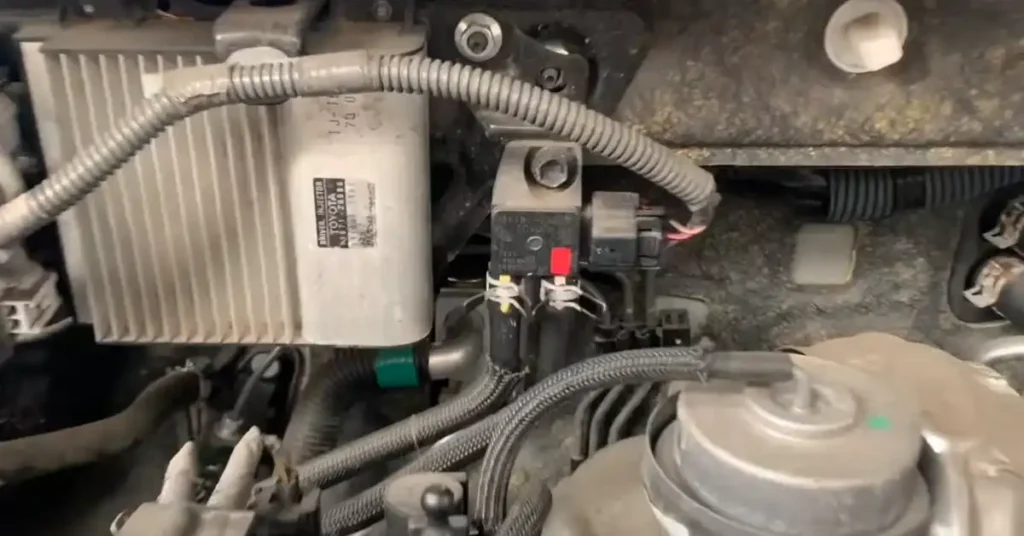
Toyota RAV4 DPF pressure sensor
Short answer: short trips prevent proper regeneration.
Diesel RAV4s experience DPF clogging when exhaust temperatures remain low. EGR cooler leaks and sensor drift worsen the issue.
Diagnostic steps
- Read differential pressure sensor data
- Monitor exhaust gas temperatures
- Review regeneration history
- Inspect EGR cooler for coolant loss
Correct repair order
- Restore regeneration conditions
- Replace failed sensors
- Clean or replace DPF if ash-loaded
- Address upstream oil or coolant leaks
Paint peeling and body issues (2008–2017, white paint)
Short answer: poor primer adhesion causes paint delamination.
Certain white paint codes suffer from factory adhesion failure. Toyota issued extended paint support programs in multiple markets.
Owner workaround
Full re-priming is the only permanent fix. Spot repairs fail over time.
2023–2025 Toyota RAV4 Recalls and Emerging Issues
Short answer: the newest RAV4 problems are software-driven, not mechanical.
While fifth-generation RAV4 mechanical components remain strong, 2023–2025 models are seeing an uptick in software and electronic reliability complaints. These issues rarely strand the vehicle immediately but create repeat warnings, battery drain, or intermittent system failures when ignored.
2025 Instrument Panel Software Recall
Short answer: the display can go blank due to a software failure, not hardware damage.
Toyota issued Recall 25V595000 affecting certain 2025 RAV4 models where the instrument cluster display may intermittently go black while driving.
What happens technically
- Instrument panel ECU fails to initialize correctly after sleep cycle
- CAN communication interruption between cluster and main ECU
- No loss of drivability, but loss of speed, warning, and system data
Correct fix
- Dealer software reflash of the instrument panel ECU
- No component replacement required if addressed early
Rearview Camera Freeze Recall (2023–2026)
Short answer: camera feed can freeze due to memory handling errors.
Recall 25V744000 affects select 2023–2026 RAV4 models where the rearview camera image may freeze or fail to display.
Root cause
- Multimedia ECU buffer overflow during camera signal processing
- More common after extended driving or repeated short trips
Correct fix
- Multimedia software update
- Camera hardware replacement is rarely required
Newer Owner Complaints in 2025 Models
Short answer: parasitic battery drain is now the top complaint.
Owners of 2025 RAV4 petrol and hybrid models are increasingly reporting unexplained 12V battery drain, even when the vehicle is parked overnight.
DCM Parasitic Drain Explained
Short answer: the Data Communication Module fails to enter sleep mode.
What owners report
- Dead battery after 24–72 hours
- No warning lights before shutdown
- Issue repeats even after battery replacement
Technical explanation
- DCM remains in “network search” mode
- Constant cellular handshake prevents system sleep
- Drains 12V battery while vehicle is off
Correct diagnostic direction
- Check quiescent draw with ammeter
- Update DCM firmware
- Replace DCM only if software update fails
2023–2026 Tech Watch: The Software Frontier
Short answer: modern reliability is now defined by code, not metal.
Post-facelift RAV4s rely heavily on OTA updates for multimedia, safety, and communication systems. Failed or incomplete updates can cause ghost faults that mimic electrical failure.
Common symptoms
- Random warning lights
- Battery drain without fault codes
- Infotainment resets or freezing
Technician insight
If a 2024+ RAV4 repeatedly kills its 12V battery and no mechanical fault is found, the DCM or multimedia firmware is likely stuck in an active state.
Correct fix
- Verify firmware version at dealer
- Force module reset and update
- Load-test battery after update to confirm sleep current
Quick diagnostic reference table
| Symptom | Likely System | First Check |
| Oil loss | Engine | Measure consumption rate |
| Hybrid warning | Electrical | 12-volt battery load test |
| Hesitation | Transmission | ECM software update |
| Steering noise | EPS | Voltage and ground test |
| DPF light | Emissions | Pressure and EGT sensors |
Technical Check: OBD-II Fault Codes That Actually Matter
Short answer: fault codes point to systems and conditions, not automatic part replacement.
Modern Toyota RAV4s log fault codes early, often before drivability becomes severe. Interpreting these codes correctly prevents unnecessary part swapping and helps technicians isolate whether the issue is mechanical, electrical, or software-related.
Common Toyota RAV4 OBD-II and Body Codes
| Issue Area | Potential Fault Code | What It Indicates | Correct Diagnostic Direction |
| Throttle Position Sensor (TPS) | P0121, P0122 | Throttle signal out of range or low voltage | Inspect throttle body for carbon buildup, test TPS reference voltage, perform throttle relearn |
| Engine Misfire | P0300–P0304 | Random or cylinder-specific misfires | Inspect spark plugs, ignition coils, injector balance, and compression |
| Excessive Oil Consumption | P0171 | Lean condition due to oil burning or air leaks | Check PCV system, intake leaks, oil consumption rate, piston ring condition |
| Hybrid System Warning | P0A80 | Hybrid battery deterioration | Test HV battery block voltages, confirm cooling fan operation, verify 12V battery health |
| Inverter Cooling | P0A93 | Inverter cooling system performance | Inspect inverter coolant pump, coolant flow, and temperature sensors |
| CVT / ECM Hesitation | P2714, P0741 | Torque management or pressure control fault | ECM update, adaptive reset, fluid condition check |
| Electric Power Steering | C1555, C1521 | EPS motor or voltage irregularity | Load-test battery, inspect ground points, check EPS wiring |
| Airbag / SRS Fault | B1346 | Occupant restraint system fault | Inspect clock spring, SRS wiring, impact sensors |
| DPF Efficiency (Diesel) | P2002 | DPF below efficiency threshold | Check regeneration history, differential pressure sensor, exhaust temperature sensors |
| EGR Flow Fault | P0401 | Insufficient exhaust gas recirculation | Inspect EGR valve, cooler, and soot blockage |
| Fuel Pump Control | P0627 | Low-pressure fuel pump control fault | Verify fuel pump relay, wiring, and fuel pressure |
Technician note
Clearing codes without reviewing freeze-frame data often hides the real failure pattern. Battery voltage, coolant temperature, and engine load at the time of the fault provide critical context.
Why this matters for owners
Short answer: early diagnostics prevent cascading failures.
Forum data from Toyota Owners Club, Reddit, and Quora shows many RAV4 failures escalate because early fault codes are ignored or misinterpreted. Addressing root causes early often prevents repeat warnings, limp mode, or secondary component damage.
Safest Toyota RAV4 years to buy
Short answer: late-cycle models show the lowest fault density.
| Category | Model Years | Reason |
| Safest | 2020–2024 | Mature software and drivetrains |
| Good with checks | 2016–2018 | Early hybrid refinement |
| Use caution | 2019 | High recall and complaint volume |
| Avoid if possible | 2001–2003, 2006–2008 | ECM and oil consumption issues |
What real RAV4 owners report after 5–10 years
Short answer: problems develop slowly and give warnings.
Across Toyota Owners Club, Reddit, and Quora, owners describe the same pattern: oil usage dismissed early, hybrid warnings ignored, and transmission hesitation normalized until escalation.
A repeated sentiment appears often:
“The car never failed suddenly. I just didn’t act early enough.”
Final verdict
Short answer: the RAV4 rewards informed ownership.
When buyers choose the right year, monitor oil and electrical health, and respect drivetrain behaviour, the RAV4 delivers exceptional longevity. Most major failures are preventable with correct diagnosis and timely intervention.
MotorHub UAE: Why RAV4 Reliability Changes in Desert Conditions
Short answer: heat, humidity, and sand stress electronics more than mileage.
In the UAE, RAV4 ownership introduces challenges rarely seen in global reliability data.
Hybrid “Cablegate” in UAE Conditions
While commonly associated with salt corrosion, UAE cases differ.
Local cause
- High humidity plus sand ingress
- HV cable connector under rear seat traps moisture and dust
- Leads to isolation faults and hybrid warnings
Preventive approach
- Periodic inspection of HV cable seals
- Interior moisture control
- Early diagnosis prevents HV system shutdown
Dubai / UAE Service Interval Comparison
| System | Global Interval | UAE Recommendation | Reason |
| Cabin AC filter | 20,000 km | 10,000 km | Dust and sand saturation |
| Hybrid cooling intake | Inspect yearly | Inspect every 10,000 km | Prevent battery overheating |
| 12V battery test | 2–3 years | Every 12 months | Heat-related degradation |
| Cooling system check | Visual | Pressure test annually | Prevent heat-induced leaks |
MotorHub insight
Most repeat RAV4 faults in the UAE trace back to heat-accelerated electrical aging, not design defects.
MotorHub UAE connects RAV4 owners with workshops experienced in hybrid diagnostics, software updates, and desert-specific preventive servicing. Correct local care is what separates a trouble-free RAV4 from a frustrating one.
FAQ: Your RAV4 Questions Answered (2026 Edition)
1. Why does my 2024–2026 RAV4 battery keep dying after two days?
Short answer: This is likely a DCM (Data Communication Module) parasitic drain. The DCM is responsible for Toyota’s “Connected Services.” In newer models, a software bug can cause the module to stay “awake” while searching for a cellular signal, draining the 12V battery in 24–72 hours.
The Fix: Ask your dealer for a DCM Firmware Update. Do not just replace the battery, or the new one will fail too.
2. Is “Cablegate” still an issue for the 2025 and 2026 Hybrid models?
Short answer: Partially. Toyota has redesigned the connector to be “open-bottom” to prevent water/salt buildup, but long-term exposure can still cause issues. For UAE owners, the risk shifts from “road salt” to “sand and humidity.” Fine desert dust trapped in the connector can hold moisture against the terminals, leading to high-voltage isolation faults.
The Fix: We recommend an annual cleaning and dielectric grease application to the rear motor connector during your major service.
3. How much does it cost to replace a RAV4 Hybrid battery in 2026?
Short answer: Between AED 11,000 and AED 29,000 ($3,000 – $8,000) for a new OEM pack, including labor. While rare within the first 10 years, costs have stabilized due to a robust secondary market.
Expert Tip: Many “battery failures” are actually just clogged cooling fans. Before replacing a pack, ensure the hybrid battery air filter (located under the rear seat) is free of dust and pet hair.
4. Can I buy a 2019 RAV4, or should I avoid it?
Short answer: Buy with caution. The 2019 model was the first year of the 5th Generation and carries the highest volume of technical service bulletins (TSBs), specifically for transmission hesitation and leaking roof rails.
The Fix: If buying a 2019, verify that the ECM/TCM software has been updated and that the roof rail gaskets were replaced under the Toyota warranty extension program.
5. Why is my 2025 RAV4’s digital dashboard going blank?
Short answer: This is a known software initialization error (Recall 25V595000). The instrument cluster sometimes fails to “wake up” after the vehicle’s sleep cycle. It is purely a software glitch and does not require replacing the physical screen.
The Fix: A 30-minute dealer reflash solves this permanently.