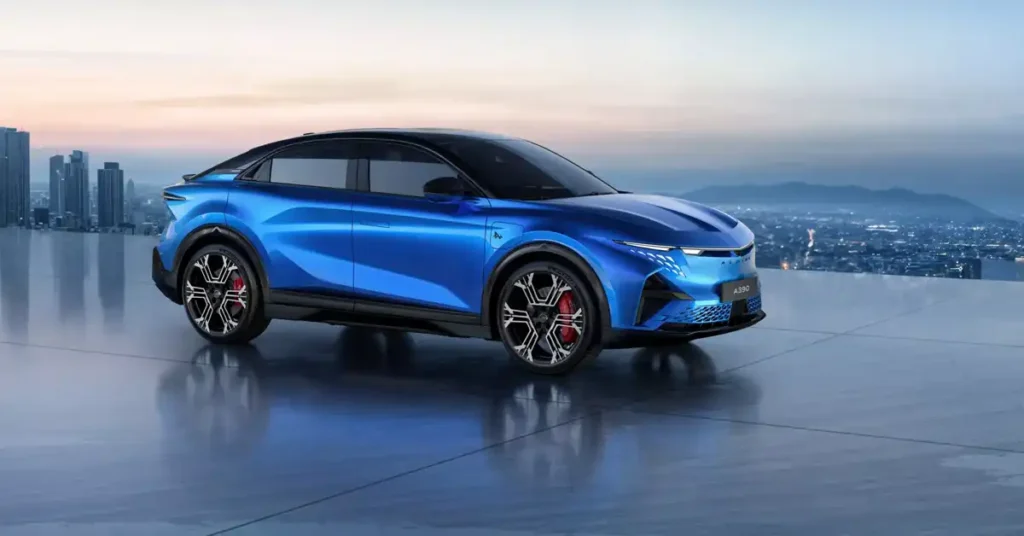
The Alpine A390 is not chasing the EV arms race with numbers alone. Instead, it prioritises balance, repeatable performance, and genuine driver engagement. With a three-motor layout, true torque vectoring, motorsport-inspired controls, Alpine Telemetrics, and a high-performance battery, it marks Alpine’s most credible electric performance statement to date.
Information and media provided courtesy of Alpine
What exactly is the Alpine A390?
Short answer: It is Alpine’s first electric sport fastback designed to deliver real driver engagement, not just straight-line speed.
The Alpine A390 is a five-door electric sport fastback positioned above the A110 coupe and alongside the smaller A290. It blends modern EV architecture with Alpine’s long-standing obsession with balance, agility, and feedback.
At 4.615 m long, it is Alpine’s largest production car so far, yet it remains compact by premium EV standards. The brief was clear: this is not a soft luxury cruiser, but a car that still feels alert, responsive, and involving on challenging roads.
Problem–Agitate–Solution: Why performance EVs often disappoint enthusiasts
The problem
Short answer: Many performance EVs are fast once, then fade.
Modern EVs can deliver huge acceleration figures, but repeated hard driving often triggers power reduction. Heat buildup, battery limitations, and conservative software strategies quickly dull the experience.
The agitation
Enthusiasts commonly complain that:
- Power drops after one or two hard launches
- Steering feels numb under sustained load
- Torque delivery is managed by brakes rather than hardware
Across forums and social media, the same frustration appears repeatedly: impressive numbers, shallow involvement.
The Alpine solution
Short answer: Alpine engineered hardware first, software second. The A390 uses three motors, dedicated cooling circuits, and genuine torque vectoring hardware to deliver repeatable performance, not just a single impressive sprint.
Design philosophy: A fastback shaped by function
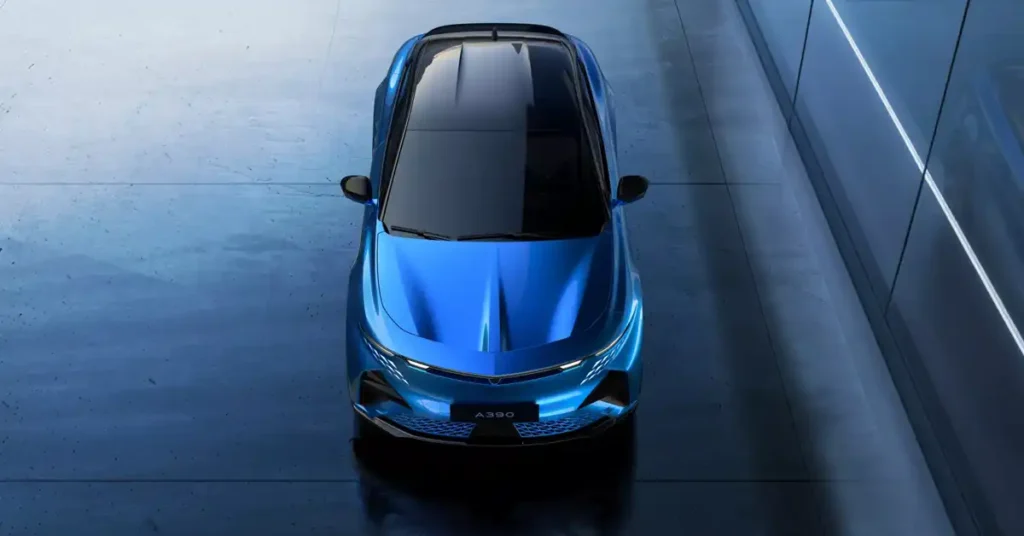
Image courtesy: Media Alpinecars
Short answer: The A390 looks dramatic because every surface has a job.
Its coupé-style fastback silhouette incorporates:
- A 17° roof angle
- Sculpted bonnet blade to manage airflow
- A rear diffuser inspired by endurance racing
The signature “Cosmic Dust” triangular lighting reinforces Alpine’s motorsport DNA without drifting into visual excess. This is performance-led design, not styling theatre.
Chassis fundamentals: Why the A390 feels lighter than it is
Short answer: Balance and geometry matter more than headline weight.
Key engineering decisions include:
- A short 2.708 m wheelbase
- Near-perfect 49:51 front–rear weight distribution
- Forged aluminium suspension components
The battery is mounted low in a skateboard layout, lowering the centre of gravity. Combined with a very quick steering ratio, the result is a car that changes direction with minimal delay and strong mid-corner confidence.
Powertrain explained simply
Short answer: Three motors are about control, not just power.
The A390 features:
- One wound-rotor motor at the front
- Two permanent-magnet motors at the rear
This configuration enables Alpine Active Torque Vectoring, where torque is independently varied between the rear wheels. Instead of breaking the inside wheel, the system actively overdrives the outer wheel, creating natural rotation and sharper turn-in.
This is hardware-led vehicle dynamics, not software masking.
Performance figures that actually matter
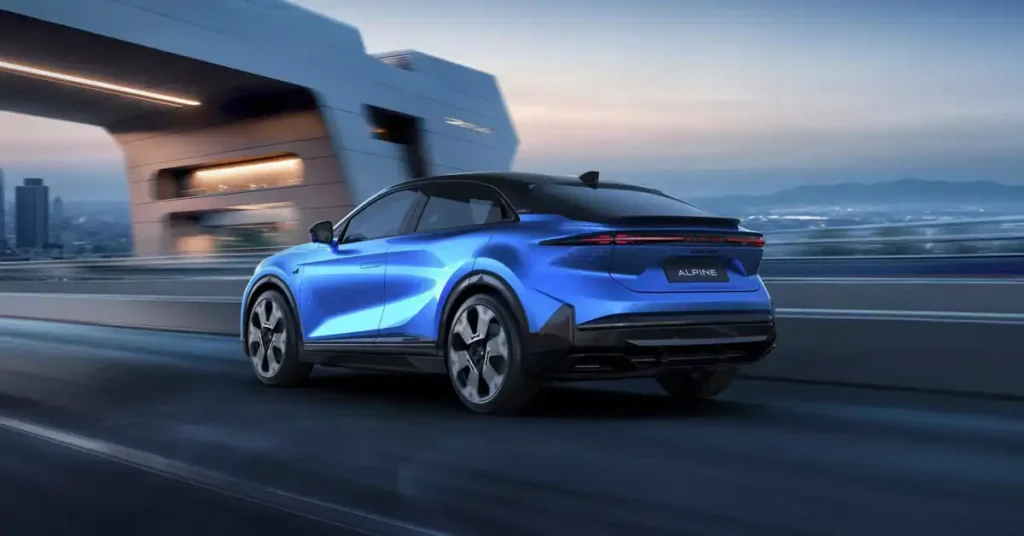
Image courtesy: Media Alpinecars
Short answer: Acceleration is quick, but consistency is the real achievement.
Two versions are offered:
- A390 GT: 400 hp, 0–100 km/h in 4.8 s, top speed 200 km/h, 661 Nm of torque
- A390 GTS: 470 hp, 0–100 km/h in 3.9 s, top speed 220 km/h, up to 824 Nm of peak torque
Some early reports cited lower torque figures for the GTS, but official specifications now confirm 824 Nm, reinforcing its role as the true performance flagship.
More important than the numbers is that the A390 can deliver them repeatedly.
Repeatable performance: Why the battery is the real breakthrough
Short answer: The A390 is engineered to sustain output, not just advertise range.
The 89 kWh battery, developed with French specialist Verkor, prioritises discharge capability and thermal stability over marketing-friendly figures.
Key characteristics include:
- High-nickel NMC chemistry
- Reinforced liquid cooling with higher flow rates
- Calibrated to maintain strong output down to around 30% state of charge
This approach directly addresses one of the biggest weaknesses of many performance EVs: power fade after repeated acceleration or prolonged high-load driving.
Driver interface: Motorsport thinking, road-car execution
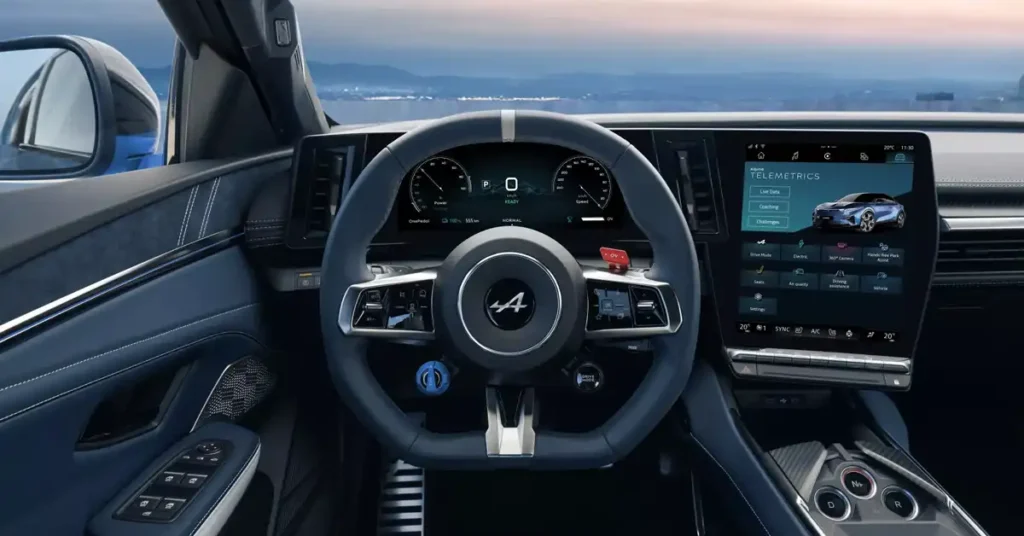
Image courtesy: Media Alpinecars
Short answer: Alpine gives drivers physical, intuitive control.
The red “OV” Overtake button
A dedicated red OV (Overtake) button on the steering wheel delivers a temporary power boost.
- Provides a 10-second surge of maximum output
- Requires a short cooling-off period
- Protects battery and drivetrain longevity
This mirrors motorsport energy-deployment logic rather than constant full-load stress.
The blue regeneration dial
A physical blue dial allows instant adjustment of regenerative braking:
- From near-free coasting
- To strong one-pedal driving
Crucially, this can be adjusted without diving into menus, even mid-corner or in traffic.
Alpine Telemetrics: the enthusiast’s data layer
The central infotainment system includes Alpine Telemetrics, a performance-focused interface that displays live vehicle data. Most notably, drivers can see real-time torque vectoring distribution, visualising exactly how power is being sent to each rear wheel as they drive.
For tech-savvy owners, this adds genuine insight — and a strong “cool factor” — while reinforcing the car’s engineering transparency.
Interior: Sport first, luxury second
Short answer: The cabin is designed around the driver, not the screen.
Key highlights:
- 12.3-inch digital instrument cluster
- 12-inch vertical central touchscreen
- Physical climate and drive controls
Alcantara, Nappa leather, and aluminium trim create a focused, premium environment without unnecessary ornamentation.
Boot space stands at 532 litres, showing that everyday practicality has not been sacrificed for performance.
Safety and driver assistance
Short answer: Assistance systems support driving without diluting it.
Available features include:
- Adaptive cruise control with stop & go
- Driver attention monitoring
- Emergency braking (forward and reverse)
- Safe exit warning
Importantly, Alpine allows easy configuration or deactivation via a dedicated My Safety button, keeping the driver in charge.
Charging, range, and thermal readiness
Short answer: Charging speed is solid, but thermal control defines usability.
- Battery capacity: 89 kWh
- DC fast charging: up to 190 kW
- 15–80% charge in under 25 minutes
Range clarification
- Up to 555 km WLTP with 20-inch wheels
- Approximately 515–520 km WLTP for the flagship GTS with 21-inch wheels
The slightly lower range of the GTS is a direct result of its wider tyres, higher grip levels, and performance-focused setup. This is a deliberate trade-off in favour of handling and power, not an efficiency shortcoming.
A standard heat pump helps preserve range in both cold climates and high-ambient conditions.
Pricing reality for 2026
Short answer: The A390 is more competitive than expected.
Indicative pricing places it at:
- A390 GT: around £61,390 (≈ USD 77,000)
- A390 GTS: around £69,390 (≈ USD 87,000)
Considering the bespoke chassis tuning, three-motor drivetrain, and advanced cooling systems, the A390 undercuts several premium performance EV rivals on engineering depth.
Enthusiast reaction: What the community is saying
Short answer: Credibility matters more than hype.
Across enthusiast discussions, several themes recur:
- Appreciation for real torque vectoring instead of brake-based systems
- Interest in sustained performance rather than single launches
- Cautious optimism about weight, balanced by trust in Alpine’s chassis tuning
A commonly echoed sentiment can be summarised as:
“Most EVs are quick. Very few are fun twice.”
The A390 earns respect because its engineering choices directly address this concern.
Quick reference table
| Component | Specification | Why it matters |
| Motors | Three-motor AWD | Enables true torque vectoring |
| Battery | 89 kWh Verkor NMC | Sustained high discharge |
| Peak torque | Up to 824 Nm (GTS) | Strong, repeatable acceleration |
| Boost | Red OV button | Controlled peak power |
| Regen | Blue steering dial | Instant driver adjustment |
| Telemetrics | Live torque display | Transparency & engagement |
| Cooling | High-flow liquid | Prevents power fade |
MotorHub perspective: Performance EVs in extreme heat
Short answer: Thermal resilience defines long-term satisfaction.
In high-ambient regions such as the Middle East, repeated acceleration, aggressive climate control use, and long highway drives quickly expose weaknesses in EV design.
Vehicles with:
- Robust cooling systems
- Intelligent energy deployment
- Hardware-led dynamics
consistently age better and deliver more stable performance. The A390’s engineering direction aligns well with these real-world demands.
Final takeaway
The Alpine A390 is not trying to dominate every spec sheet. It is trying to feel right.
By prioritising balance, physical controls, repeatable power delivery, transparent telemetrics, and honest feedback, Alpine has created one of the few electric performance cars that enthusiasts can respect beyond the first test drive.
If electric performance cars are the future, the A390 proves they do not have to forget where driving pleasure comes from.